
What's inside
As an Amazon Associate I earn from qualifying purchases. This post may contain affiliate links at no extra cost to you.
Finding the best 3D printer for student engineers is different from finding a 3D printer for hobbyists, because a 3D printer for student engineers has to offer precision for engineering parts, speed for class projects, and a price that fits a student budget, without being too slow, too inaccurate, or too hard to use, even though it still has to offer a good build volume, a strong frame, and a design that fits a dorm room. A good 3D printer for student engineers should offer a build volume of at least 180 x 180 x 180 mm, a print speed of at least 250 mm/s, and a price of $600 or less, so it can be used for engineering projects, for class assignments, for prototypes, and for a first 3D print. A poor printer will be too small, it will be too slow, or it will be inaccurate, and your parts will not fit, your projects will be late, and your engineering work will be less successful.
This guide compares seven real, currently sold 3D printers for student engineers, with prices from $180 to $800 in the table below: the Bambu Lab A1 Mini, Bambu Lab P1S, Prusa MK4S, Creality Ender-3 V3 SE, Anycubic Kobra 3, Elegoo Neptune 4 Pro, and FlashForge Adventurer 5M. Their build volumes run from 180 x 180 x 180 mm to 256 x 256 x 256 mm, their print speeds run from about 250 mm/s to about 600 mm/s, their nozzles run from 0.4 mm to 0.4 mm, their prices run from $180 to $800, and their ratings run from 4.5 to 4.7 out of 5. Every model here is sold as a 3D printer, every model can be used by student engineers, and every model costs $800 or less at its typical price range. The right choice depends on your projects, your budget, and whether you want a fast printer or a cheap printer.
Build volume, precision, and speed are the first factor for the best 3D printer for student engineers, because build volume decides how large a part a printer will make, precision decides whether a part will fit, and speed decides how fast a printer will finish a project. Build volume is listed in mm, with a larger build volume best, because it will make larger parts. The Bambu Lab A1 Mini at $200 to $300 has a build volume of 180 x 180 x 180 mm, the Bambu Lab P1S at $500 to $600 has a build volume of 256 x 256 x 256 mm, the Prusa MK4S at $700 to $800 has a build volume of 250 x 210 x 220 mm, the Creality Ender-3 V3 SE at $180 to $220 has a build volume of 220 x 220 x 250 mm, the Anycubic Kobra 3 at $250 to $300 has a build volume of 250 x 250 x 260 mm, the Elegoo Neptune 4 Pro at $250 to $300 has a build volume of 225 x 225 x 265 mm, and the FlashForge Adventurer 5M at $300 to $400 has a build volume of 220 x 220 x 220 mm. For student engineers, a build volume of at least 180 x 180 x 180 mm is a good starting point, because it will make most engineering parts, and a build volume of 256 x 256 x 256 mm, such as the Bambu Lab P1S, is best if you want the largest parts. Precision is also important, because it is how accurate a printer is, with a printer that offers a layer height of 0.1 mm best, because it will offer smooth parts. Speed is also important, because it is how fast a printer prints, with a faster printer best, because it will finish projects quickly.
Material, ease of use, and software are the second factor, because a 3D printer for student engineers has to offer material that fits engineering parts, ease of use that lets a student print quickly, and software that is easy to learn. Material is what a printer prints with, with PLA best for beginners, because it is easy to print, PETG best for engineering parts, because it is strong, and ABS best for high temperature parts, because it is durable. The Bambu Lab A1 Mini at $200 to $300 prints PLA and PETG, the Bambu Lab P1S at $500 to $600 prints PLA, PETG, and ABS, the Prusa MK4S at $700 to $800 prints PLA, PETG, and ABS, the Creality Ender-3 V3 SE at $180 to $220 prints PLA and PETG, the Anycubic Kobra 3 at $250 to $300 prints PLA and PETG, the Elegoo Neptune 4 Pro at $250 to $300 prints PLA and PETG, and the FlashForge Adventurer 5M at $300 to $400 prints PLA and PETG. For student engineers, a printer that prints PETG is best, because it offers strong parts. Ease of use is also important, because a printer with auto bed leveling is best, because it will level the bed automatically, and a printer with a simple setup is best, because it will let you print quickly. Software is also important, because software that is easy to learn is best, because it will help you slice models.
Price, dorm use, and noise are the third factor, because a 3D printer for student engineers has to be affordable enough for a student, small enough for a dorm room, and quiet enough for a shared space. Price is also important, because a printer in the $180 to $220 range, such as the Creality Ender-3 V3 SE, is a good starting point, and a printer in the $700 to $800 range, such as the Prusa MK4S, offers a premium build. Dorm use is also important, because a printer that is compact is best, because it will fit in a dorm room, and a printer that is enclosed is best, because it will reduce noise and fumes. Noise is also important, because a printer that is quiet is best for a dorm room, with a printer that offers a quiet mode best, because it will let you print at night.
Use, and the best first printer are the fourth factor, because a 3D printer for student engineers has to be useful for your projects, and offer a quality that fits engineering work. Use is how a printer helps your work, with a printer best for engineering projects, for class assignments, for prototypes, and for a first 3D print. A good 3D printer for student engineers, chosen for build volume first and used with PLA for beginners, will offer precision, speed, and value for engineering projects.
Our Top Picks
Best 3D Printer for Student Engineers: At a Glance
Use this table to compare build volume, print speed, nozzle, price range, and rating. Build volume and print speed are the two figures most student engineers should check first, because they decide how large a part the printer will make and how fast it will finish a project.
| Model | Build Volume | Print Speed | Nozzle | Typical Price Range | Rating out of 5 |
|---|---|---|---|---|---|
| Bambu Lab A1 Mini | 180 x 180 x 180 mm | About 500 mm/s | 0.4 mm | $200 – $300 | 4.7 |
| Bambu Lab P1S | 256 x 256 x 256 mm | About 500 mm/s | 0.4 mm | $500 – $600 | 4.7 |
| Prusa MK4S | 250 x 210 x 220 mm | About 250 mm/s | 0.4 mm | $700 – $800 | 4.6 |
| Creality Ender-3 V3 SE | 220 x 220 x 250 mm | About 250 mm/s | 0.4 mm | $180 – $220 | 4.6 |
| Anycubic Kobra 3 | 250 x 250 x 260 mm | About 600 mm/s | 0.4 mm | $250 – $300 | 4.6 |
| Elegoo Neptune 4 Pro | 225 x 225 x 265 mm | About 500 mm/s | 0.4 mm | $250 – $300 | 4.5 |
| FlashForge Adventurer 5M | 220 x 220 x 220 mm | About 600 mm/s | 0.4 mm | $300 – $400 | 4.5 |

FLASHFORGE Creator 5 Pro 3D Printer, 4-Toolhead Multi-Color, Enclosed | 65°C Heated Chamber for Engineering Filaments, Near-Zero Purge Waste, 5X Faster Printing, CoreXY 600mm/s, HEPA 13 Filtration
As an Amazon Associate we earn from qualifying purchases. Product prices and availability are accurate as of the date/time indicated.

Personalized 3D Printer Ornament Custom Maker Christmas Decoration | Custom 3D Printer Ornament With Name, Unique Christmas Tree Decor For Makers, Engineers, Designers And 3D Printing Fans


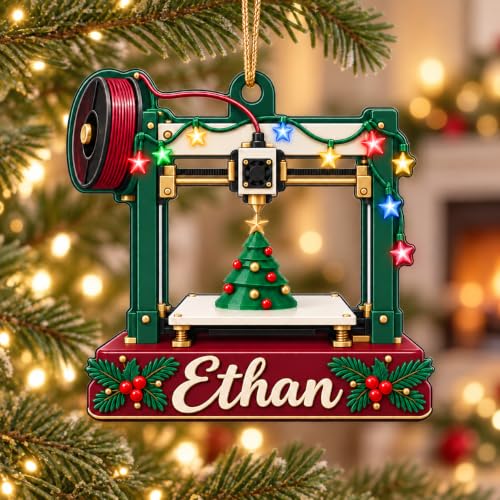


As an Amazon Associate we earn from qualifying purchases. Product prices and availability are accurate as of the date/time indicated.
Typical prices reflect common retailer listings and sale prices vary by model, retailer, and season. Build volume, print speed, and nozzle are manufacturer-listed approximate values and can vary by model and configuration. Print speed is a maximum value, and actual speed depends on material, layer height, and model complexity.
Best 3D Printer for Student Engineers: The 7 Printers Reviewed
1. Bambu Lab A1 Mini: Best 3D Printer for Student Engineers Overall
The Bambu Lab A1 Mini, at $200 to $300 with a rating of 4.7 out of 5, has a build volume of 180 x 180 x 180 mm, a print speed of about 500 mm/s, and a 0.4 mm nozzle. It is the joint highest-rated printer in this guide, and the best overall printer here for most student engineers, because it offers a fast speed, a simple setup, and a low price.
It suits a student engineer, a buyer who wants a Bambu Lab printer, and a user who wants a compact printer. The 500 mm/s speed is fast, the auto bed leveling is easy, and the $200 to $300 price is low. The trade-off is build volume: at 180 x 180 x 180 mm, it offers less volume than the Bambu Lab P1S at 256 x 256 x 256 mm and $500 to $600. For the best overall 3D printer for student engineers at $200 to $300, it is the strongest choice here.
Best for: Most student engineers who want a 180 mm, 500 mm/s printer for $200 to $300.
2. Bambu Lab P1S: Best Large 3D Printer for Student Engineers
The Bambu Lab P1S, at $500 to $600 with a rating of 4.7 out of 5, has a build volume of 256 x 256 x 256 mm, a print speed of about 500 mm/s, and a 0.4 mm nozzle. It is the joint highest-rated printer in this guide, and the best large printer here for a student engineer who wants a Bambu Lab printer.
It suits a student engineer, a buyer who wants a Bambu Lab printer, and a user who wants a large printer. The 256 x 256 x 256 mm build volume is the largest here, the enclosed design reduces noise, and the $500 to $600 price is moderate. The trade-off is price: at $500 to $600, it is higher than the Bambu Lab A1 Mini at $200 to $300. For a large 3D printer for student engineers at $500 to $600, it is a strong choice.
Best for: Large use with a 256 mm, 500 mm/s printer for $500 to $600.
3. Prusa MK4S: Best Premium 3D Printer for Student Engineers
The Prusa MK4S, at $700 to $800 with a rating of 4.6 out of 5, has a build volume of 250 x 210 x 220 mm, a print speed of about 250 mm/s, and a 0.4 mm nozzle. It is the best premium printer here for a student engineer who wants a Prusa printer.
It suits a student engineer, a buyer who wants a Prusa printer, and a user who wants a premium printer. The PrusaSlicer software is easy to learn, the build quality is high, and the $700 to $800 price is high but it offers a premium printer here. The trade-off is speed: at about 250 mm/s, it offers less speed than the Anycubic Kobra 3 at about 600 mm/s and $250 to $300. For a premium 3D printer for student engineers at $700 to $800, it is a practical choice.
Best for: Premium use with a 250 mm, 250 mm/s printer for $700 to $800.
4. Creality Ender-3 V3 SE: Best Cheap 3D Printer for Student Engineers
The Creality Ender-3 V3 SE, at $180 to $220 with a rating of 4.6 out of 5, has a build volume of 220 x 220 x 250 mm, a print speed of about 250 mm/s, and a 0.4 mm nozzle. It is the best cheap printer here for a student engineer who wants a Creality printer.
It suits a student engineer, a buyer who wants a Creality printer, and a user who wants a cheap printer. The $180 to $220 price is low, the 220 x 220 x 250 mm build volume is good, and the auto bed leveling is easy. The trade-off is also speed, as above. For a cheap 3D printer for student engineers at $180 to $220, it is a practical choice.
Best for: Cheap use with a 220 mm, 250 mm/s printer for $180 to $220.
5. Anycubic Kobra 3: Best Fast 3D Printer for Student Engineers
The Anycubic Kobra 3, at $250 to $300 with a rating of 4.6 out of 5, has a build volume of 250 x 250 x 260 mm, a print speed of about 600 mm/s, and a 0.4 mm nozzle. It is the best fast printer here for a student engineer who wants an Anycubic printer.
It suits a student engineer, a buyer who wants an Anycubic printer, and a user who wants a fast printer. The 600 mm/s speed is the fastest here, the 250 x 250 x 260 mm build volume is large, and the $250 to $300 price is moderate. The trade-off is also speed vs quality: at high speed, print quality can be lower, so use a slower speed for engineering parts. For a fast 3D printer for student engineers at $250 to $300, it is a practical choice.
Best for: Fast use with a 250 mm, 600 mm/s printer for $250 to $300.
6. Elegoo Neptune 4 Pro: Best Value 3D Printer for Student Engineers
The Elegoo Neptune 4 Pro, at $250 to $300 with a rating of 4.5 out of 5, has a build volume of 225 x 225 x 265 mm, a print speed of about 500 mm/s, and a 0.4 mm nozzle. It is the best value printer here for a student engineer who wants an Elegoo printer.
It suits a student engineer, a buyer who wants an Elegoo printer, and a user who wants a value printer. The 500 mm/s speed is fast, the 225 x 225 x 265 mm build volume is good, and the $250 to $300 price is moderate. The trade-off is rating: at 4.5 out of 5, it is slightly lower than the Bambu Lab A1 Mini at 4.7 out of 5 and $200 to $300. For a value 3D printer for student engineers at $250 to $300, it is a practical choice.
Best for: Value use with a 225 mm, 500 mm/s printer for $250 to $300.
7. FlashForge Adventurer 5M: Best Enclosed 3D Printer for Student Engineers
The FlashForge Adventurer 5M, at $300 to $400 with a rating of 4.5 out of 5, has a build volume of 220 x 220 x 220 mm, a print speed of about 600 mm/s, and a 0.4 mm nozzle. It is the best enclosed printer here for a student engineer who wants a FlashForge printer.
It suits a student engineer, a buyer who wants a FlashForge printer, and a user who wants an enclosed printer. The 600 mm/s speed is fast, the enclosed design reduces noise, and the $300 to $400 price is moderate. The trade-off is also rating, as above. For an enclosed 3D printer for student engineers at $300 to $400, it is a useful starting point.
Best for: Enclosed use with a 220 mm, 600 mm/s printer for $300 to $400.
Best 3D Printer for Student Engineers Buying Guide: What Actually Matters in 2026
Choosing a 3D printer for student engineers is easier when you decide on build volume, speed, and price before you look at material or software. Those three choices decide how large a part the printer will make, how fast it will finish a project, and whether it fits a student budget.
Best 3D Printer for Student Engineers Buying Guide: Build Volume, Precision, and Speed
Build volume, precision, and speed are the first factor. For build volume, choose at least 180 x 180 x 180 mm, such as the Bambu Lab A1 Mini at $200 to $300, because it will make most engineering parts, and 256 x 256 x 256 mm, such as the Bambu Lab P1S at $500 to $600, if you want the largest parts. For precision, choose a printer that offers a layer height of 0.1 mm, because it will offer smooth parts, and use a 0.4 mm nozzle for most parts. For speed, choose at least 250 mm/s, such as all seven printers here, because it will finish projects quickly, and 600 mm/s, such as the Anycubic Kobra 3 at $250 to $300, if you want the fastest printer.
Best 3D Printer for Student Engineers Buying Guide: Material, Ease of Use, and Software
Material, ease of use, and software are the second factor. For material, choose PLA for beginners, because it is easy to print, and PETG for engineering parts, because it is strong. For ease of use, choose a printer with auto bed leveling, because it will level the bed automatically, and a printer with a simple setup, because it will let you print quickly. For software, choose software that is easy to learn, such as Bambu Studio or PrusaSlicer, because it will help you slice models, and check that the software works with your computer before you buy.
Best 3D Printer for Student Engineers Buying Guide: Price, Dorm Use, and Noise
Price, dorm use, and noise are the third factor. For price, choose a printer in the $180 to $220 range, such as the Creality Ender-3 V3 SE, if price is the main factor, and a printer in the $500 to $600 range, such as the Bambu Lab P1S, if you want a large printer. For dorm use, choose a compact printer, because it will fit in a dorm room, and an enclosed printer, because it will reduce noise and fumes. For noise, choose a printer with a quiet mode, because it will let you print at night, and place your printer on a stable surface, because it will reduce vibration.
Best 3D Printer for Student Engineers Buying Guide: Price, and the Best First Printer
Price, and the best first printer are the final factors. For price, a printer in the $200 to $300 range, such as the Bambu Lab A1 Mini, is a good starting point. A printer in the $700 to $800 range, such as the Prusa MK4S, offers a premium build. Choose by build volume first, then by speed, then by price, then by material.
For the best first setup, buy a 3D printer for student engineers, PLA filament, and a slicing program. The Bambu Lab A1 Mini at $200 to $300 is a good first printer for most student engineers, the Creality Ender-3 V3 SE at $180 to $220 is a good first printer if price is the main factor, and the Bambu Lab P1S at $500 to $600 is a good first printer if you want a large printer. A good 3D printer for student engineers, chosen for build volume first and used with PLA for beginners, will offer precision, speed, and value for engineering projects.
Best 3D Printer for Student Engineers FAQ
What is the best 3D printer for student engineers?
The Bambu Lab A1 Mini, at $200 to $300 with a rating of 4.7 out of 5, is the best 3D printer for student engineers overall in this guide. It has a build volume of 180 x 180 x 180 mm, a print speed of about 500 mm/s, and a 0.4 mm nozzle. If you want a large printer, the Bambu Lab P1S at $500 to $600 with a rating of 4.7 out of 5 is the best choice, with a build volume of 256 x 256 x 256 mm and a print speed of about 500 mm/s. If you want a cheap printer, the Creality Ender-3 V3 SE at $180 to $220 with a rating of 4.6 out of 5 is the best choice, with a build volume of 220 x 220 x 250 mm.
What build volume do student engineers need?
For student engineers, a build volume of at least 180 x 180 x 180 mm is a good starting point, because it will make most engineering parts, and a build volume of 256 x 256 x 256 mm, such as the Bambu Lab P1S at $500 to $600, is best if you want the largest parts. The Bambu Lab A1 Mini at $200 to $300, Prusa MK4S at $700 to $800, Creality Ender-3 V3 SE at $180 to $220, Anycubic Kobra 3 at $250 to $300, Elegoo Neptune 4 Pro at $250 to $300, and FlashForge Adventurer 5M at $300 to $400 are all at least 180 mm, so they are good for student engineers. Choose a larger build volume if you make large parts, and a smaller build volume if you make small parts.
Is PLA or PETG better for engineering projects?
For engineering projects, PETG is better than PLA for functional parts, because it is stronger and more durable, and PLA is better for beginners, because it is easy to print. The Bambu Lab A1 Mini at $200 to $300, Bambu Lab P1S at $500 to $600, Prusa MK4S at $700 to $800, Creality Ender-3 V3 SE at $180 to $220, Anycubic Kobra 3 at $250 to $300, Elegoo Neptune 4 Pro at $250 to $300, and FlashForge Adventurer 5M at $300 to $400 all print PLA and PETG, so they are good for student engineers. Start with PLA for your first prints, and use PETG for parts that need strength.
What is the cheapest good 3D printer for student engineers?
The cheapest good option in this guide is the Creality Ender-3 V3 SE, at $180 to $220 with a rating of 4.6 out of 5, because it is a 220 mm, 250 mm/s printer for a low price. The Bambu Lab A1 Mini, at $200 to $300 with a rating of 4.7 out of 5, is also a low-cost option, with a 180 mm, 500 mm/s printer. The Anycubic Kobra 3, at $250 to $300 with a rating of 4.6 out of 5, is also a low-cost option, with a 250 mm, 600 mm/s printer. Start with one of these three if price is the main factor, and check build volume, speed, and material next. For the best overall value, the Bambu Lab A1 Mini at $200 to $300 is a better choice because it offers a rating of 4.7 out of 5 and a print speed of about 500 mm/s.
FAQ
What is the best 3D printer for student engineers?
What build volume do student engineers need?
Is PLA or PETG better for engineering projects?
What is the cheapest good 3D printer for student engineers?
Related guides
- Best Printer Paper for Student Essays: 6 Papers for Clear, Professional Essays in 2026
- How to Choose USB C Cable for Students: 6 Best USB-C Cables for Students in 2026
- Best High End Wireless Charger for Phone in 2026: Qi2 and MagSafe Chargers With Perfect Alignment, Cool Coils, and Desk Presence Worth Paying For
- Best Budget Phone Case for Protection in 2026: Spigen, Caseology, OtterBox, and TORRAS Cases That Save a Phone for the Price of a Lunch
More from Amazon
Programs that pair well with the guide above. Offers and eligibility are set by Amazon and may change.
Set up recurring deliveries of everyday items on eligible products. Terms and savings are set by Amazon.
Explore Subscribe & SaveFree shipping on eligible items, Prime Video and more. Eligible new members can start with a free trial.
Start a Prime free trialAudiobooks and podcasts to listen to on the go. Eligible new members can start with a free trial.
Try Audible freeRead from a large library of eBooks and audiobooks on any device. Check Amazon for current plans.
Explore Kindle UnlimitedAs an Amazon Associate we earn from qualifying purchases.

Write Your Review
No reviews yet. Be the first to share your experience!